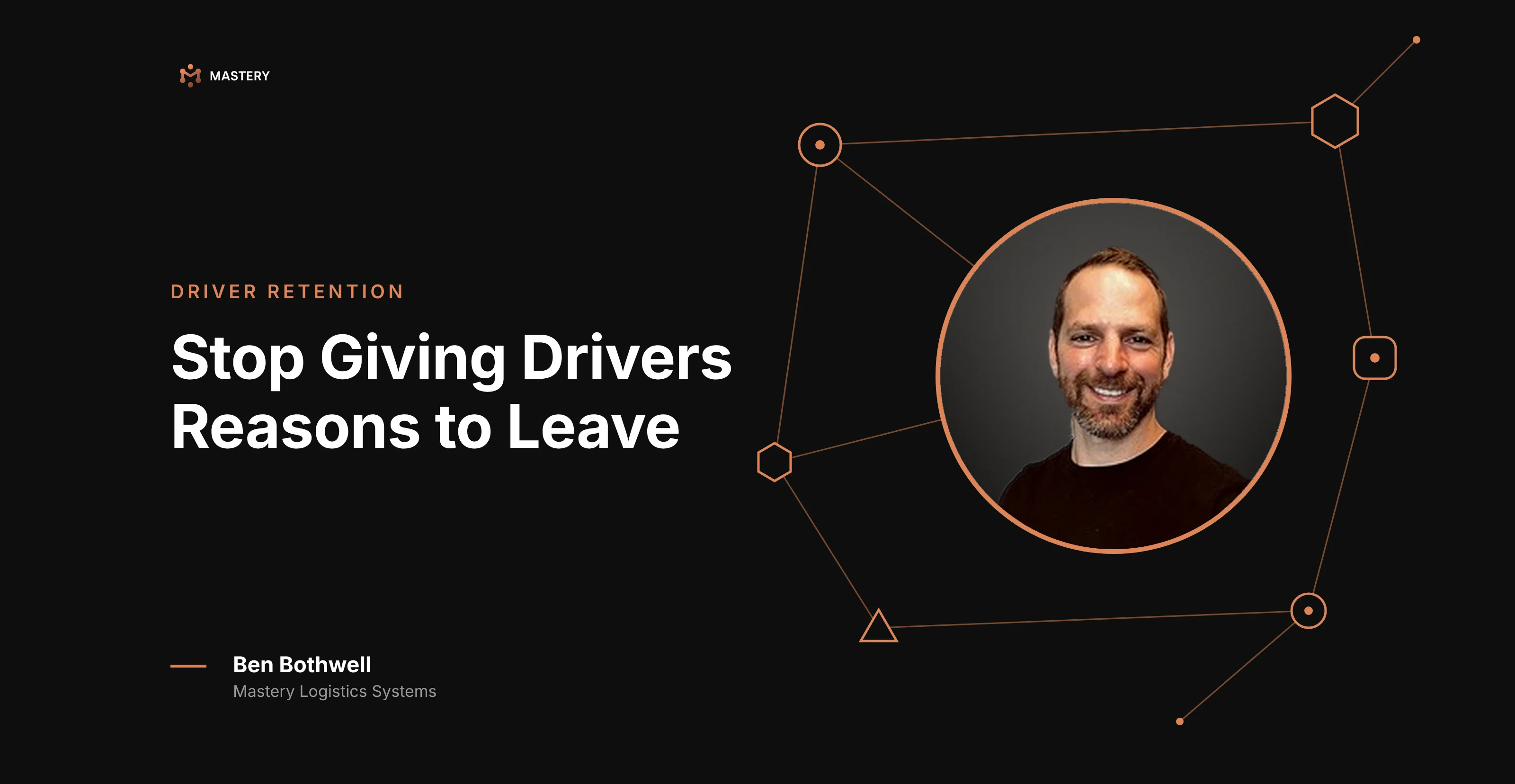
I've spent a good part of my career working in trucking operations, including managing drivers. And if there's one thing I've learned, it's that we tend to overcomplicate driver retention.
We talk about recruiting strategies, sign-on bonuses, compensation packages, and all the things carriers can do to attract new drivers. Those things matter, of course. But I think we sometimes overlook something more fundamental.
Drivers are people. They're not machines that move freight.
They want what the rest of us want from an employer. They want to be respected, paid fairly and accurately, given safe equipment, and treated like the commitments made to them matter.
Sounds pretty simple, doesn't it?
Yet when you're managing a fleet, trying to keep trucks moving, dealing with customer demands, and handling everything else that comes your way, it's surprisingly easy to lose sight of those basics.
I know because I've been on that side of the desk. And I've made some of those mistakes myself.
Getting Drivers Home Isn't Just a Scheduling Issue
Think about this scenario.
Your company sends you out of town for two weeks. You've been told you'll be home Friday, and you're looking forward to spending time with your family. Then, just as you're wrapping up, your boss calls and says you need to stay out another week.
You probably wouldn't be too happy.
Now imagine that happening repeatedly – with planning and process to blame.
That's what drivers deal with when we don't follow through on home-time commitments. It might mean missing a child's birthday, a family celebration, or simply the opportunity to spend a few days at home.
When I was managing drivers, I learned how important those commitments were. I also learned something else: When you consistently treat drivers well, you build a level of trust that can make everyone’s job easier.
If I had a driver who knew I respected his time, paid him correctly, and did my best to keep my commitments, there was a pretty good chance he'd help me out when something unexpected happened.
Maybe I needed him to stay out an extra day because of a breakdown or an urgent load. When that trust existed, he was much more likely to work with me.
But if I'd repeatedly let him down? That conversation usually went very differently.
Today, working on the technology side of the business, I see how important it is to build those commitments and relationships directly into the planning process.
With MasterMind®, a driver's home-time requests can be recorded, reviewed, and made visible to the people planning freight. Our OptiMatch optimization capabilities can also account for home time, PTO, and other commitments when recommending assignments.
That helps planners make better decisions before a load is assigned, rather than discovering later that they've created a problem for the driver.
Technology can't make every operational disruption disappear. But it can help us avoid creating unnecessary ones.
Nobody Wants to Question Their Paycheck Every Week
Here's another lesson I learned managing drivers: If someone constantly has to check whether you're paying them correctly, you've got a problem.
Driver pay can get complicated. There's mileage pay, accessorials, detention, incentives, and all kinds of compensation arrangements that vary from one carrier to another.
But the driver shouldn't have to become an expert in the payroll system to understand what they've earned.
I've seen settlement statements that were difficult for me to understand, and I've spent a lot of time working with driver pay. Imagine being a new driver trying to figure out why a particular amount appeared on your paycheck or why something you expected wasn't there.
When I was a fleet manager, I dealt with those calls firsthand.
A driver might request accessorial pay, but the message gets missed. Someone enters the wrong amount. Paperwork doesn't arrive on time, and now payment for a completed load is delayed.
There are plenty of ways for things to go wrong, even when nobody intends for them to.
And every time a driver has to call and ask about missing money, we're creating another frustrating experience that takes away time spent on building stronger relationships within the fleet.
One thing I appreciate about what we've built in MasterMind is the ability to automate more of those pay processes.
Carriers can configure pay programs that reflect their compensation structures, including changes tied to milestones or other conditions. Instead of someone remembering to manually update a driver's rate, the system can apply those rules automatically.
We've also developed automation around items such as detention pay, helping reduce some of the manual work that can lead to missed compensation.
For me, the objective is straightforward: Reduce the opportunities for mistakes, make it easier for drivers to understand their compensation, and give them confidence that they're being paid correctly.
That's not just a payroll improvement. It's part of earning their trust.
Not Every Driver Wants the Same Freight
Something else I learned quickly is that what makes a good load for one driver might make it a terrible load for another.
Some drivers like short runs because they can complete more trips. Others prefer longer hauls and spending time on the highway.
Some don't mind unloading freight if it means earning additional money. Others want nothing to do with it. Some like multistop routes; others would rather avoid them.
The point is, you have to know your drivers in a repeatable and scalable way. But there's one thing that's pretty universal: Drivers don't like to sit.
If a driver isn't moving, there's a good chance they're not earning what they could be. And from the carrier's perspective, an idle truck isn't generating the revenue it could be either.
As fleet managers, we need to balance those realities. We have freight to move and customers to serve, but we also have individual drivers with different preferences and expectations.
In many operations, that information lives in someone's head. An experienced dispatcher knows that a particular driver doesn't like certain destinations or prefers specific kinds of freight.
That's fine until the dispatcher is out, the driver gets reassigned, or you're managing so many drivers that keeping track of those preferences becomes difficult.
MasterMind allows carriers to capture driver preferences, including where drivers are willing to go and the types of work they're willing to do. OptiMatch can use those preferences when recommending driver-to-load assignments.
It's a practical way to help respect individual driver preferences while still meeting the operational needs of the business.
And I think that's important. When you repeatedly ignore what a driver wants, you're essentially telling that person they're just another truck available to move freight.
That's not a great way to keep people around.
Sometimes We Make the Driver's Job Harder Without Realizing It
One thing that's easy to forget when you're working in a trucking company's operations center is how different the driver's working environment really is.
Inside the office, planners, dispatchers, fleet managers, and other employees can talk to each other throughout the day. They have access to systems, coworkers, and information.
Meanwhile, the driver might be a thousand miles away trying to figure out what's happening.
Communication matters enormously in that environment.
Drivers need to feel like they're part of the operation, not simply the people being told what to do.
And communication goes both ways.
Let's say a driver follows the process for requesting home time. He submits the request correctly and expects the company to follow through. If that request gets overlooked, how frustrating is that?
I can tell you from experience that it happens. I was guilty of it myself when I was managing drivers.
That's why I think carriers need to pay as much attention to whether they're following their own processes as they do to whether drivers are following theirs.
Systems can help by making requests, messages, and commitments visible across the organization.
MasterMind's integrated driver messaging also helps keep communication connected to the work being performed, so important conversations aren't lost across disconnected channels.
But regardless of the technology, the underlying principle is the same: Drivers need to know that someone is listening and following through.
The Best Driver Technology Gets Out of the Driver's Way
I'm going to say something that might sound strange coming from someone who works for a transportation technology company.
I think we're reaching a point where drivers can have too much technology pushed at them.
Think about everything drivers are asked to manage today. Different applications, messages, documents, load updates, and other electronic processes.
Some drivers are very comfortable with technology. Others aren't. And there's nothing wrong with that.
Our job shouldn't be to force every driver to become a technology expert.
It should be to make their jobs easier.
I believe technology should be along for the ride, not constantly in the driver's face.
For example, if we already have location information that tells us a driver has arrived at or departed a facility, why should we always require the driver to manually update that information? When the workflow supports it, the technology can handle that step.
Of course, drivers also need to understand how those automated processes work. Automation shouldn't create new confusion.
The same philosophy applies to paperwork, load information, communication, and pay visibility. Those things should be simple to access and easy to understand.
I recently worked with a Mastery customer that had been operating in a very manual environment. Their drivers had access to some technology, but the various processes weren't brought together in one place.
With MasterMind Drive, our driver mobile application, they were able to simplify that experience.
Drivers could work from one application to manage their loads, upload paperwork, communicate, and see pay information without navigating multiple disconnected processes.
What stood out to me wasn't simply that the company introduced new technology. It was that the technology made everyday tasks easier for both the drivers and the people supporting them.
That's how I believe technology should work.
Get out of the driver's way and let them do what they do best.
Driver Retention Starts With How We Run Our Operations
I don't believe there's a single piece of technology or one recruiting initiative that solves driver retention.
But I do believe carriers have more control over the driver experience than they sometimes realize.
We control how we communicate. We control how we handle driver requests. We control whether our pay processes are accurate and understandable. We control whether we're making thoughtful assignments or simply treating drivers as available capacity.
And we can make decisions about the technology and processes we put in place to support those responsibilities.
Having worked on both sides of the business, I appreciate how difficult it can be to balance customer expectations, profitability, equipment utilization, and the needs of individual drivers.
Nobody gets it right every time. I certainly didn't.
But I learned that when drivers trust you, respect you, and believe you're doing your best to take care of them, they're much more willing to work with you when things don't go according to plan.
That trust doesn't come from a recruiting campaign.
It comes from what happens every day after the driver joins your fleet.
If we want to keep good drivers, we need to stop giving them reasons to leave.
See How MasterMind Supports Driver-First Operations
MasterMind brings driver preferences, planning, dispatch, pay, and mobile workflows together in one transportation management platform, helping carriers simplify operations and better support the people behind the wheel